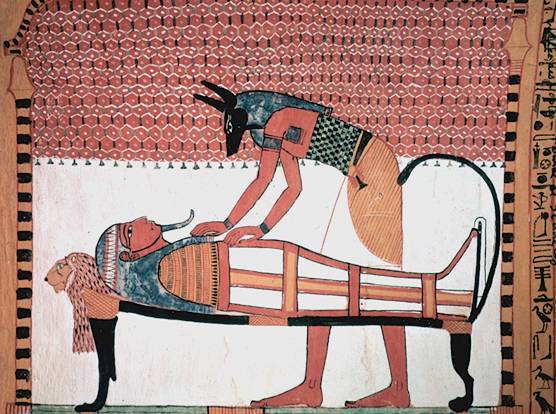
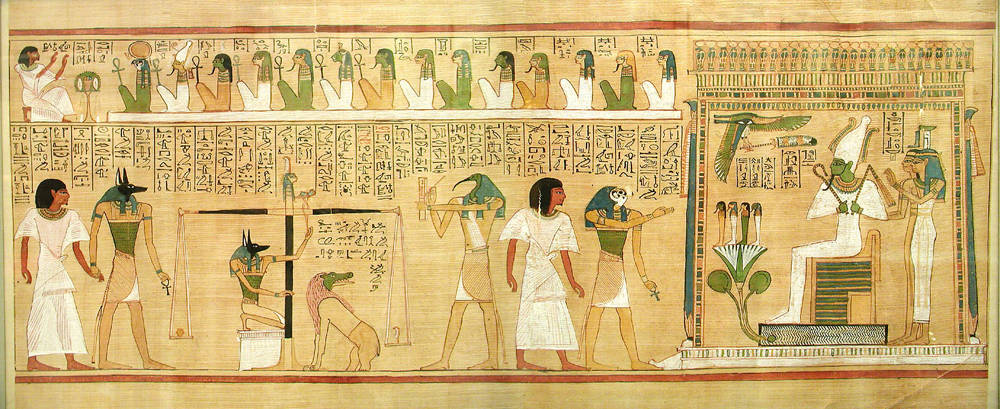
Anubis was the god who handled the body. For the whole of the Old Kingdom (c. 2600–2181 BCE) he was the sole Lord of the Dead, the jackal who haunted the desert cemeteries where real jackals scavenged the graves, turned by the Egyptians into their guardian instead of their threat. He presided over mummification — the seventy-day work of drying, packing and wrapping the corpse — and his priests carried out the rites in wooden jackal masks, becoming the god for the duration. In the Hall of Judgement he ran the scales, weighing the heart of each dead person against the feather of Maat while Thoth recorded the verdict and the devourer Ammit waited. From the Middle Kingdom (c. 2040 BCE) Osiris absorbed much of this and took the title Lord of the Dead, but Anubis kept the practical office: the embalming table, the scales, the door to the necropolis.
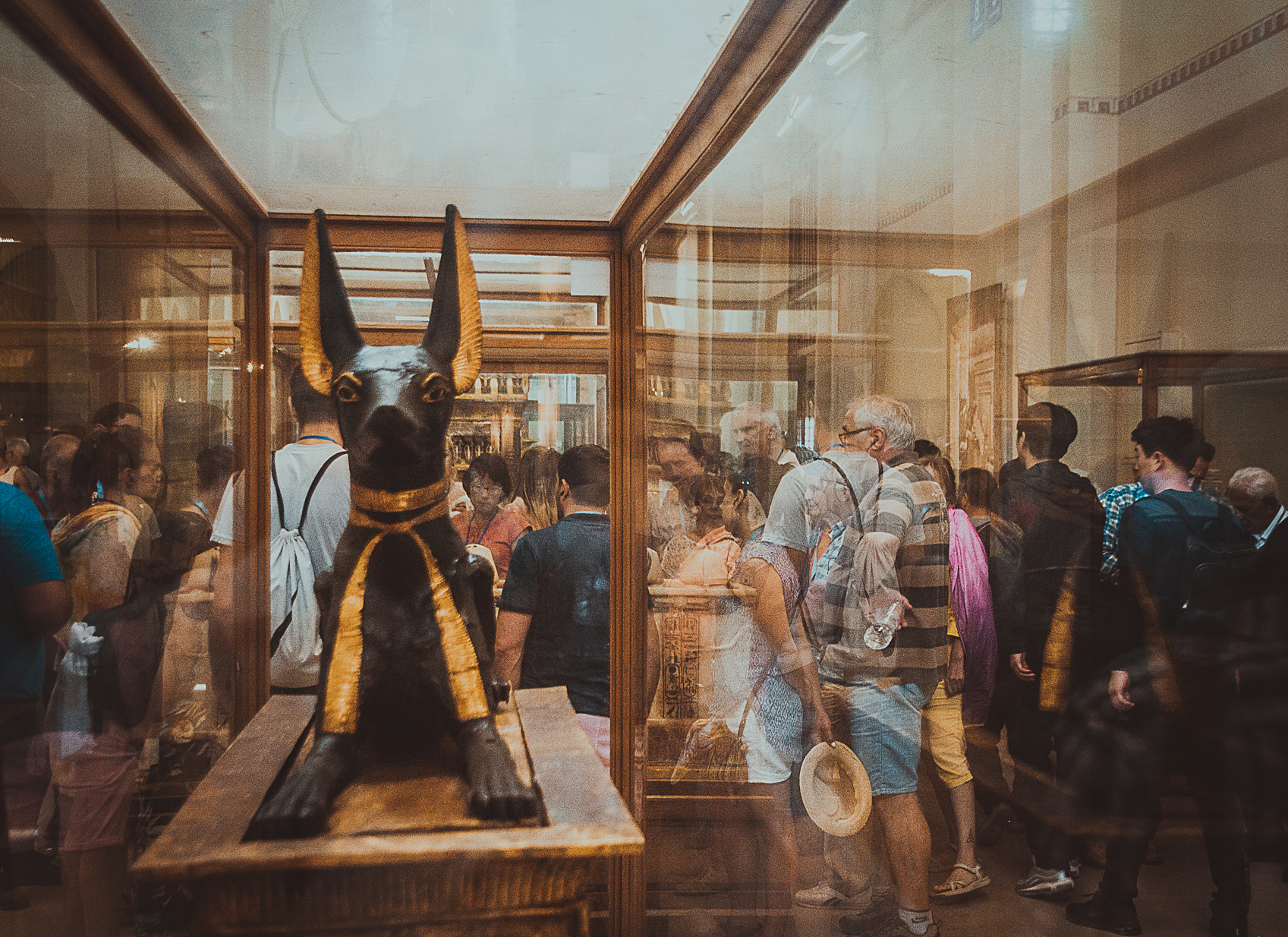
He died when the machinery he ran was switched off. As Christianity became the religion of Roman Egypt, the temples emptied, hieroglyphic worship stopped — the last dated inscription was cut at Philae in 394 CE — and around 537 the temple of Philae, the final working sanctuary of the old gods, was shut under Justinian. Mummification itself ended; the rite Anubis governed was abandoned along with the gods who explained it. What is left is object and image. His black jackal still lies on its shrine in the Egyptian Museum in Cairo (JE 61444), the weighing of the heart still runs across museum papyri, and the name “Anubis” now belongs to films, video games and tattoos. Nobody embalms a body in his name. The god of the dead outlived his own death only as a face behind glass.
Worth remembering
- In the Hall of Two Truths, Anubis worked the scales: he weighed the heart of the dead against the single feather of Maat, goddess of truth. A heart heavier than the feather was thrown to the monster Ammit and devoured; a heart that balanced let its owner pass into the afterlife.
- Priests of Anubis performed embalming wearing wooden jackal-head masks of the god, standing in for Anubis himself as they bound the corpse. The most famous image of him survives recumbent and black: the cedar jackal of the Anubis Shrine (JE 61444), set facing west in Tutankhamun's tomb to guard the way to the dead.
Gallery
Sources
- Anubis is the Egyptian god of mummification, funerary rites, guardian of tombs and guide to the afterlife; in the Early Dynastic Period and Old Kingdom he was the sole Lord of the Dead and judge of the soul, and his priests wore wooden masks of the god during rituals. As the Osiris myth grew more popular, Osiris took on more of Anubis' attributes and replaced him as Lord of the Dead by the Middle Kingdom. World History Encyclopedia
- Anubis was the god of cemeteries and embalming, guardian and protector of the dead, usually depicted as a jackal or a man with a jackal's head; he was associated with the mummification process. The British Museum
- The Anubis Shrine from Tutankhamun's tomb (find no. 261, inventory JE 61444) is a recumbent jackal of wood covered with black paint, with gold-leaf detailing, found behind the entrance leading from the Burial Chamber to the Treasury; it is displayed at the Egyptian Museum in Cairo. Wikipedia
A graveyard tradition: leave a stone to show you came, and remembered.