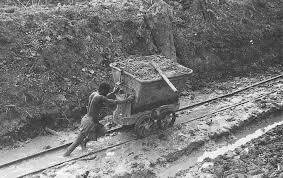
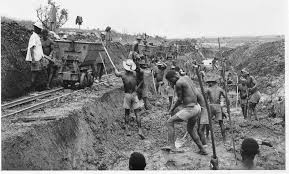
Diamang held something close to absolute power over a piece of colonial Angola. Granted a total monopoly on the country’s diamonds in 1917, it ran its concession in the Lunda region as a private state — paying the local officials, building the infrastructure, policing the population, and controlling the labour through the forced-work system the Portuguese empire called xibalo. Its shareholders were Portuguese, Belgian, French, and American, and its profits, extracted from the alluvial diamond fields by tens of thousands of coerced workers, were among the largest of any company in colonial Africa. For sixty years it was, in effect, the government of its own corner of the continent.
Independence ended it. When Angola broke from Portugal in 1975, the new MPLA government held that the country’s diamonds belonged to Angolans, and in 1977 it nationalised Diamang. The state took majority control, set up its own diamond company, Endiama, in 1981, and by 1986 the old company was formally dissolved — leaving behind large debts and the Dundo museum it had built as much for control as for culture. Like the Mozambique Company and the other chartered enterprises in this wing, Diamang shows a particular way for a dominant company to die: not outcompeted, but reclaimed, when the people it had governed took back the thing it owned.
Worth remembering
- Diamang held a total monopoly over Angolan diamonds across roughly 52,000 square kilometres of the Lunda region, where it paid the colonial administrators' salaries, built the roads, ran the policing, and founded the Dundo ethnographic museum — a company that governed its concession like a private country.
- Its capital was deliberately multinational — Portuguese, Belgian, French, and American — and its profits were built on coerced labour: around 26,000 African workers a year in the 1930s, recruited through the xibalo forced-labour law and local chiefs under colonial pressure.
Gallery
Sources
- Diamang was nationalised by decree in August 1977 after Angolan independence; Endiama was founded in 1981 and by mid-1986 Diamang was formally dissolved, leaving large outstanding debts US Library of Congress Country Studies — Angola
- Diamang built a 'state inside the state' in the Lunda region under an exclusive monopoly, employing tens of thousands of African workers under the xibalo forced-labour system; its tax and profit payments to Portugal were enormous African Economic History (Redalyc)
A graveyard tradition: leave a stone to show you came, and remembered.