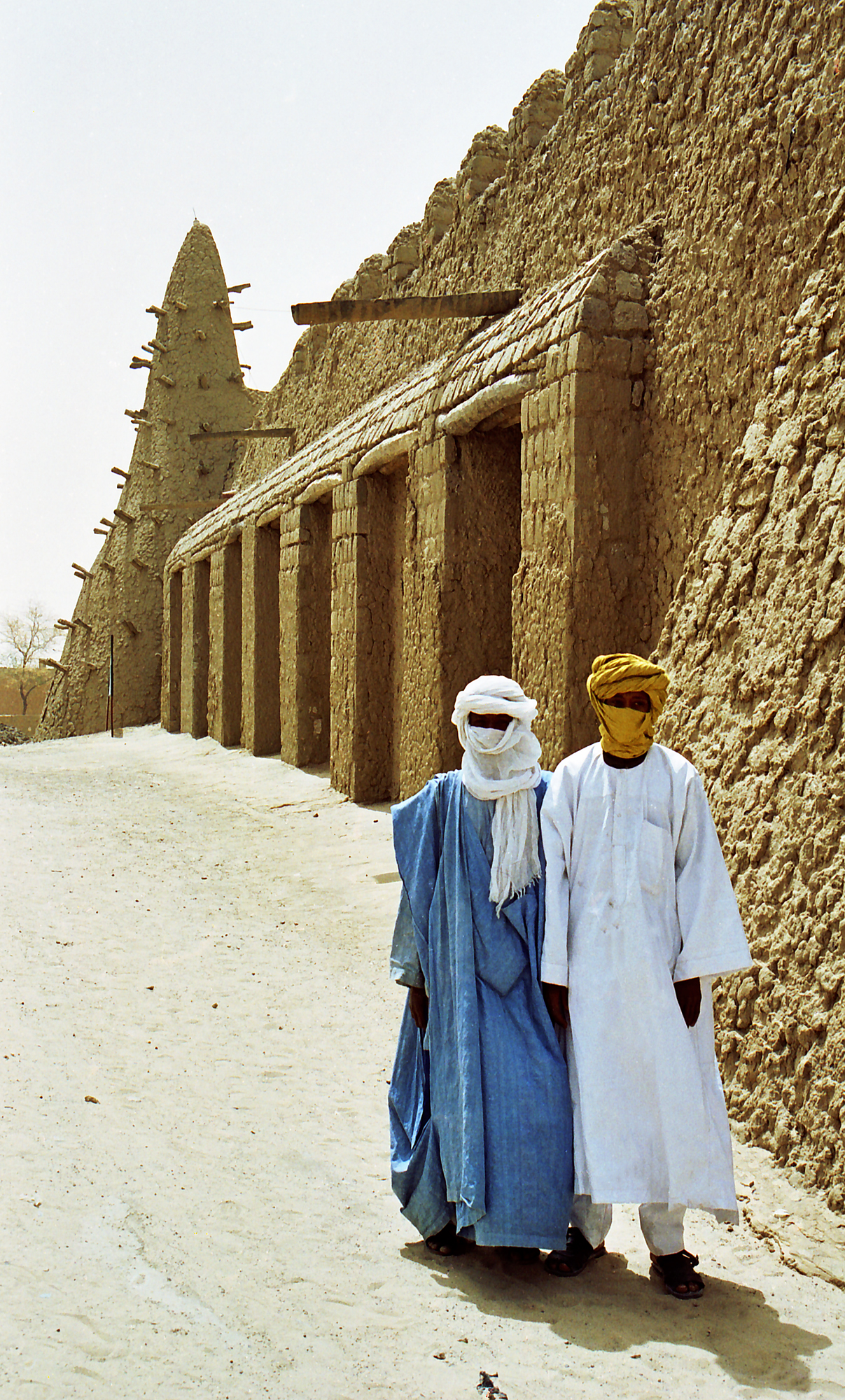
At its height in the 16th century, the Songhai Empire — built up from Gao by Sonni Ali after 1464 and reorganised by Askia Muhammad — was one of the largest states in African history, well over a million square kilometres along the Niger River, controlling the trans-Saharan trade in gold and salt. Its city of Timbuktu was a renowned centre of learning, home to the University of Sankore and a book trade so active that manuscripts were said to be among the most valuable goods in the market.
Its end was abrupt and lopsided. In 1591 the Saadi sultan of Morocco sent an army across more than a thousand kilometres of Sahara — a march that should have been suicidal — armed with arquebuses and cannon. At the Battle of Tondibi this force of a few thousand met a Songhai army many times its size, fighting with swords, spears, and cavalry. Gunpowder decided it in an afternoon. The empire fragmented into Moroccan-ruled towns and rump states, and the great Saharan centre of learning faded. Songhai is the clearest case in this museum of an old power killed not by a bigger one, but by a newer technology.
Worth remembering
- Timbuktu's Sankore mosque functioned as a university, and its book trade was so prized that manuscripts could be worth more than gold or salt.
- Askia Muhammad's pilgrimage to Mecca in the 1490s was lavish enough to enter legend across the Islamic world, echoing Mansa Musa's before it.
The people
-
Sonni Ali — Empire-builder, r. 1464–1492
Conquered Timbuktu and Djenné, turning Songhai from a kingdom into the dominant power of the western Sudan.
-
Askia Muhammad I — Great organiser, c. 1443–1538
Reformed the state, made a famous pilgrimage to Mecca, and patronised the scholars of Timbuktu.
-
Askia Ishaq II — Last emperor, r. 1588–1591
Commanded the vast Songhai army routed by Moroccan firearms at Tondibi.
Gallery
Watch
Further reading
Sources
- Songhai Empire, one of the largest in African history; destroyed in 1591 at Tondibi Wikipedia
- Songhai history, Timbuktu as a centre of learning, and the Moroccan conquest Encyclopaedia Britannica
- The Songhai Empire (c. 1460–1591) dominated West Africa's trans-Saharan trade in gold and salt; Timbuktu under Songhai rule was a major centre of Islamic scholarship World History Encyclopedia
A graveyard tradition: leave a stone to show you came, and remembered.