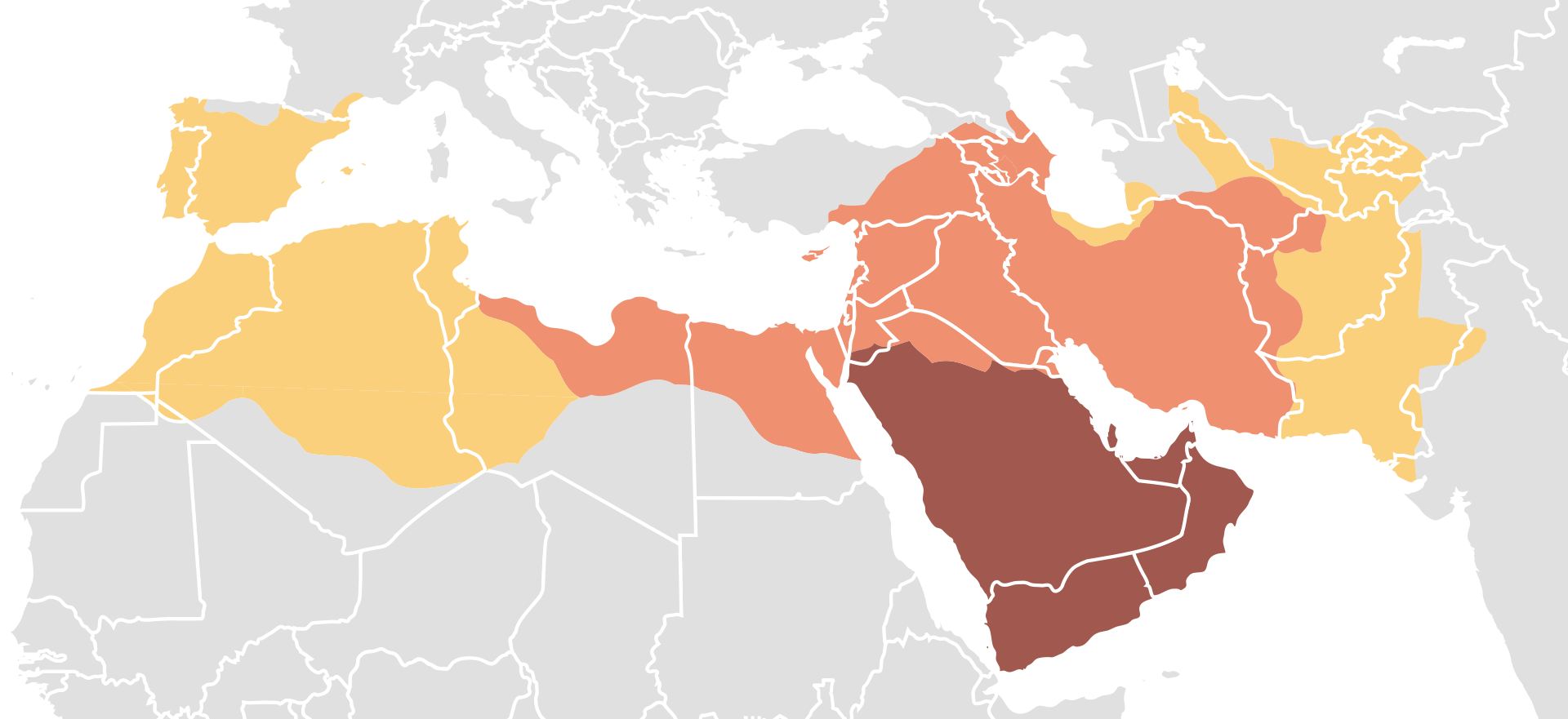
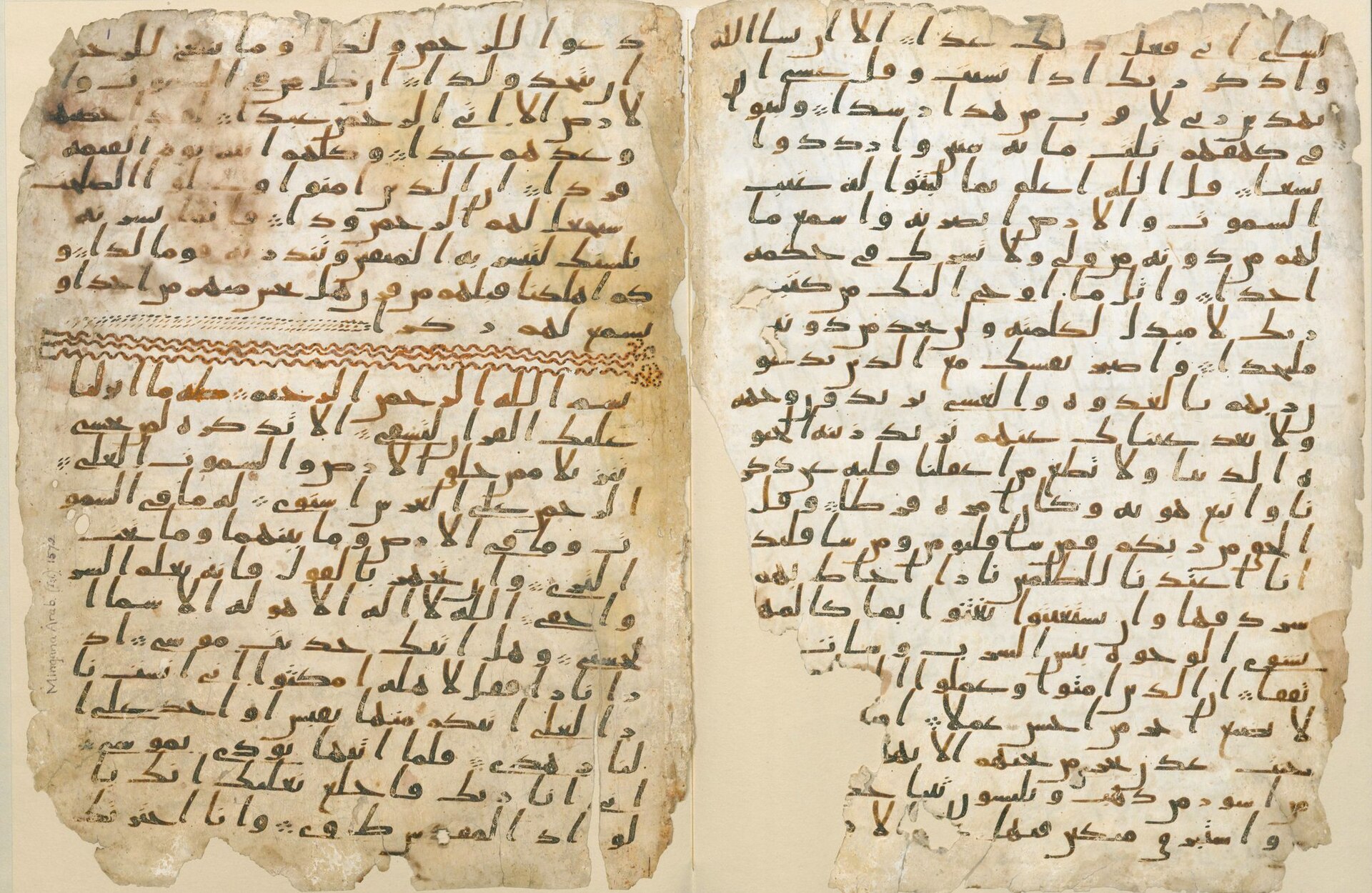
Muhammad died in 632, and within thirty years the community he left ruled from Libya to eastern Iran. Four caliphs took the title of “successor” in turn — Abu Bakr, who held Arabia together through the riddah wars; Umar, under whom the armies broke both of the great powers of the age; Uthman, who fixed the text of the Quran; and Ali, the Prophet’s cousin and son-in-law. The Sasanian Persian Empire, four centuries old, was conquered entirely between 633 and 654: Qadisiyya in 636 opened the road to the capital at Ctesiphon, and the last Sasanian emperor, Yazdegerd III, died a fugitive in 651. From the Byzantines the caliphate took Syria after the Battle of Yarmuk in 636, then Palestine and Egypt, with Alexandria falling by 641–642. It was one of the fastest large conquests in recorded history, run by a generation of men who had known Muhammad personally.
The same speed that built the empire did not hold it. Umar was stabbed by a Persian slave in 644. Uthman was killed by rebel soldiers in his own house in 656, and his death opened the First Fitna — the first Muslim civil war. Ali, the fourth caliph, fought rivals including Mu’awiya, the governor of Syria, and in 661 a Kharijite assassin killed Ali at prayer. Power passed to Mu’awiya, who founded the Umayyad dynasty and made the caliphate hereditary. The Rashidun is revered in Sunni Islam as a golden age, the one period when the community was led the way the Prophet had led it, and the quarrel over who should have succeeded Muhammad became the root of the Sunni–Shia split that is still alive fourteen centuries later. The memory has not died. The caliphate itself ended in 661.
Worth remembering
- Conquered the entire Sasanian Persian Empire and took Syria, Palestine, and Egypt from the Byzantines within roughly thirty years — winning Yarmuk against the Byzantines and Qadisiyya against the Persians in 636, capturing Damascus and Ctesiphon, and taking Alexandria by 641–642.
- Ruled by the four 'rightly-guided' caliphs in succession — Abu Bakr (632–634), Umar (634–644), Uthman (644–656), and Ali (656–661) — three of whom were assassinated: Umar by a Persian slave in 644, Uthman by rebel soldiers in 656, and Ali by a Kharijite in 661.
Gallery
Sources
- The Rashidun period (632–661 CE) was ruled by the first four caliphs Abu Bakr, Umar, Uthman, and Ali; during their reign the armies of Islam united Arabia and then conquered parts of the Byzantine Empire and the whole of the Sasanian Empire. After Uthman was murdered in 656 CE the empire fell into its first civil war, the First Fitna (656–661 CE); Ali was assassinated by a Kharijite in 661 CE, after which Mu'awiya established the Umayyad Dynasty. World History Encyclopedia
- The first four caliphs — Abu Bakr, Umar, Uthman, and Ali — ruled between 632 and 661, a period when much Byzantine and Persian territory was conquered, with victories at the Battle of Yarmuk in 636 against the Byzantines and at Qadisiyya against the Persians and the capture of Alexandria in 641; with Ali's death the Umayyads, led by Mu'awiya ibn Abi Sufyan, established Islam's first hereditary dynasty. OpenStax, World History Volume 1
- The Rashidun Caliphate lasted 632–661, ruled by Abu Bakr (632–634), Umar (634–644), Uthman (644–656), and Ali (656–661); it carried out the conquest of the Sasanian Empire (633–654), including the Battle of al-Qadisiyyah and the capture of Ctesiphon, and took Byzantine Syria and Egypt by 642. Umar was assassinated in 644, Uthman in 656, and Ali in 661. Wikipedia
A graveyard tradition: leave a stone to show you came, and remembered.