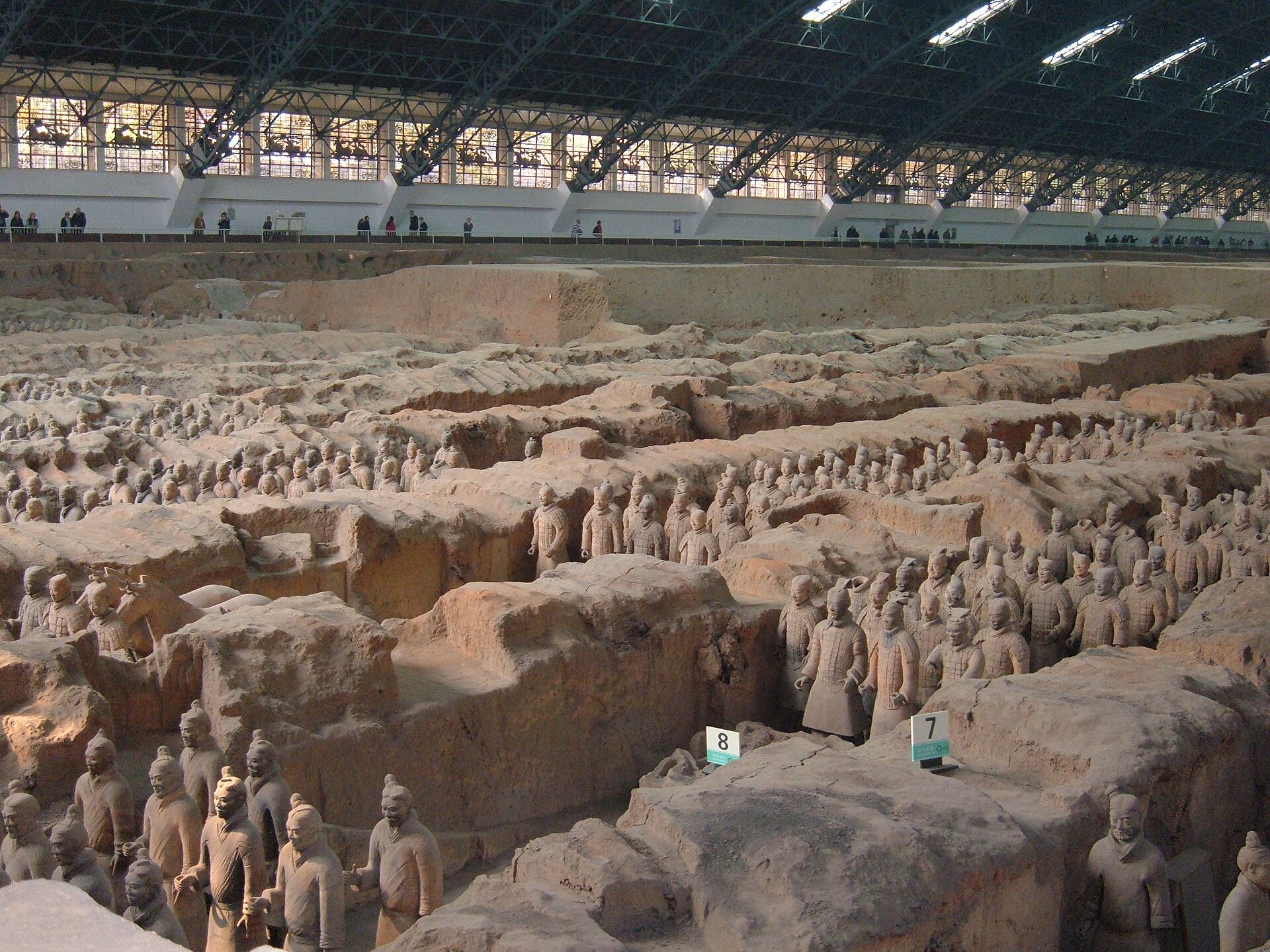
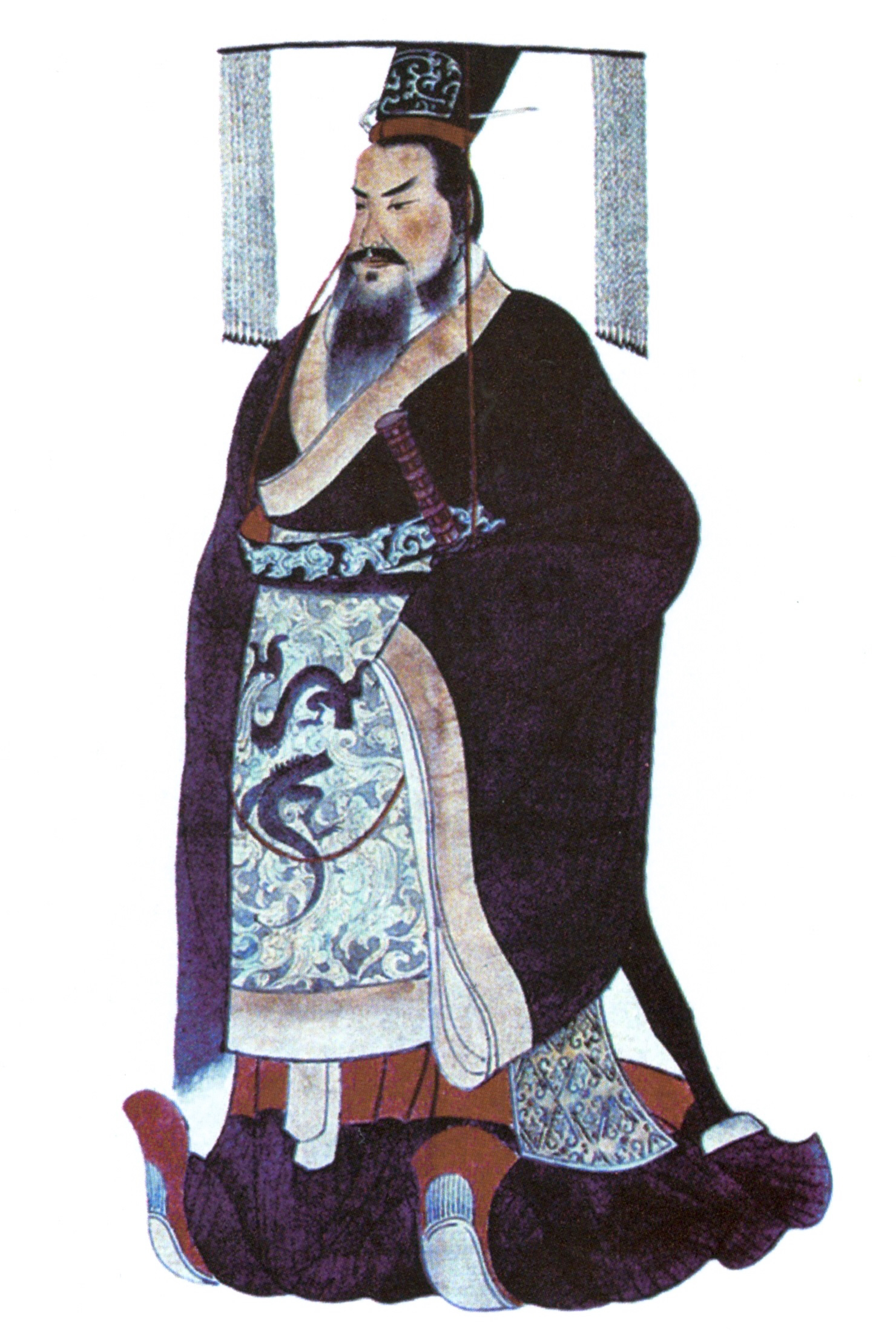
The state of Qin spent more than a century grinding through the other Warring States from its base in the northwest, and in 221 BCE King Ying Zheng took the last of them. He declared himself Shi Huangdi — first emperor — and refused the older title of king, because king was a thing there had been many of. What followed was administration as conquest. The empire ran on Legalism: rule by codified law, harsh punishment, and central control rather than the rites and precedent the old aristocracies had lived by. The Qin abolished the feudal estates and split the territory into commanderies answering to the capital. They forced one written script onto every former state, one set of weights and measures, one bronze coinage, and a single axle-width so carts could run in the same ruts across the whole road network. They connected the scattered northern walls into the first Great Wall, and conscripted hundreds of thousands of labourers to do it. In 213 BCE the government burned the books of the earlier dynasties and outlawed every school of thought except Legalism. Beneath a mound near Xi’an the emperor had an army of nearly 8,000 terracotta soldiers buried to guard him.
The whole structure depended on the one man who built it, and he died in 210 BCE while travelling in the east. His ministers concealed the death long enough to install a weak successor, Qin Er Shi, and force the emperor’s abler son to kill himself. Within a year the conscripts and the conquered states were in open revolt; the harshness that had held the empire together gave everyone a reason to break it. The dynasty collapsed in 206 BCE, fifteen years after the unification and four years after the first emperor died, and the last Qin ruler was killed. Liu Bang came out of the wars that followed and founded the Han. The Qin lost the dynasty but won the argument about how China would be governed. The Han kept the commanderies, the standardised script and coinage, the centralised bureaucracy, and the office of emperor itself — the template the Qin invented outlived the regime by more than two thousand years, through every dynasty down to 1912. The model survived. The people who built it were dead inside a generation.
Worth remembering
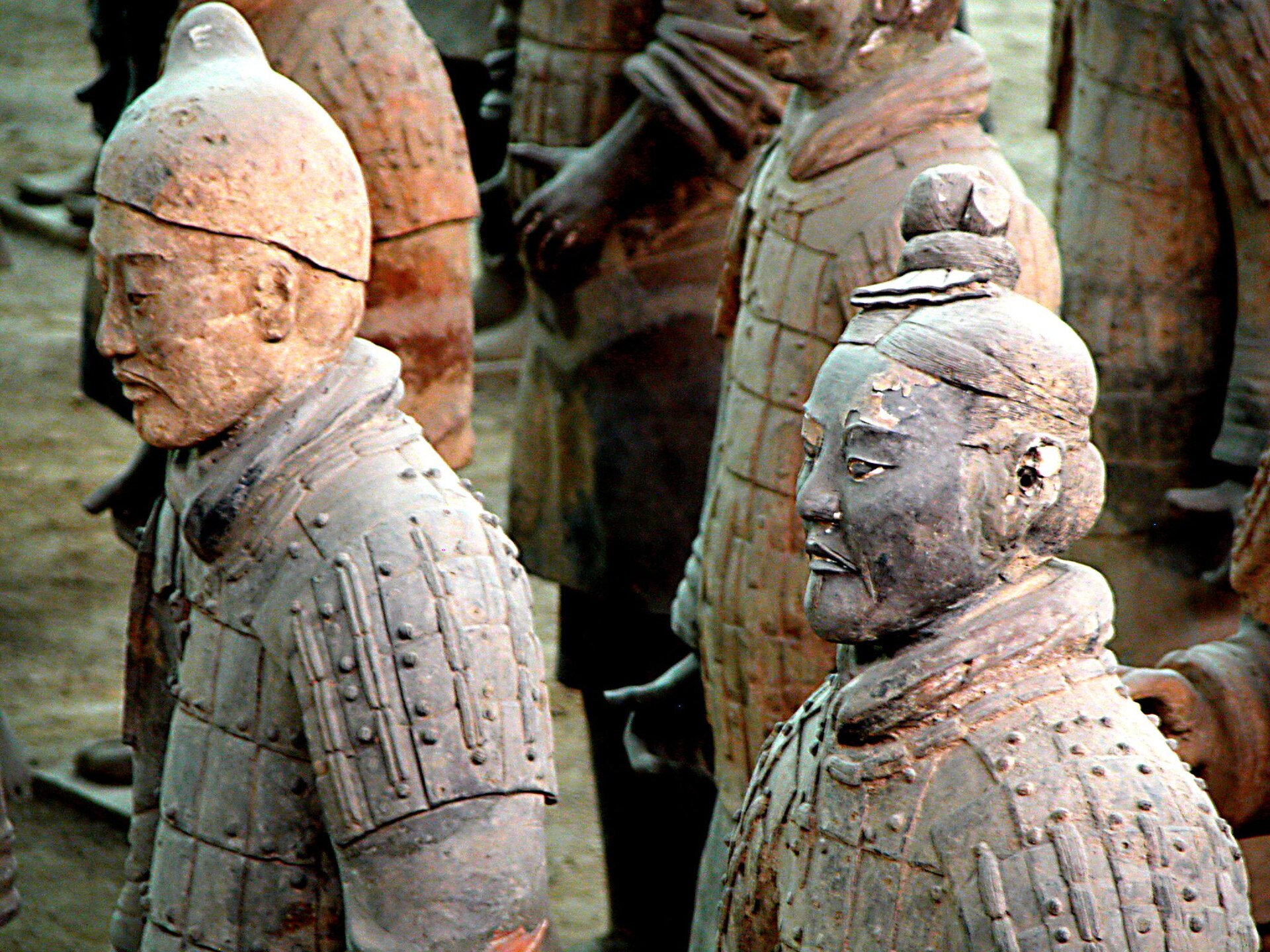
- Qin Shi Huang's tomb near Xi'an was guarded by an underground army of almost 8,000 life-size terracotta warriors and some 600 terracotta horses, with chariots and weapons, modelled individually and buried in pits to protect the emperor in death.
- The Qin imposed one written script, one set of weights and measures, one bronze coinage, and a single legal standard for cart axle-widths across the conquered states, connected the northern border walls into the first Great Wall, and in 213 BCE burned earlier dynasties' books and outlawed every philosophical school except Legalism.
Gallery
Sources
- The Qin Dynasty (221–206 BCE) was the first dynasty of Imperial China; King Ying Zheng united the separate states and proclaimed himself Shi Huangdi, 'first emperor', and the regime operated according to the philosophy of Legalism. In 213 BCE the government burned the books and outlawed all philosophical schools except Legalism. World History Encyclopedia
- The Qin seized the rival states to create a unified Chinese empire in 221 BCE and standardised the written script, weights, measures, and bronze coinage; earlier border walls in the north were connected into the beginnings of the Great Wall, and Qin Shi Huang built an army of almost 8,000 terracotta warriors. He died in 210 BCE and the empire fell to rebellion soon after, with Liu Bang founding the Han dynasty. HISTORY (A&E Television Networks)
- King Ying Zheng united the states under his single rule and proclaimed himself First Emperor, Shi Huangdi; he issued a state coinage, began the Great Wall along the empire's northern boundary, and commissioned an army of over 8,000 terracotta warriors. In 213 BCE he burned the books; he died in 210 BCE and the Qin Dynasty collapsed by 206 BCE, succeeded by the Han. World History Encyclopedia
A graveyard tradition: leave a stone to show you came, and remembered.