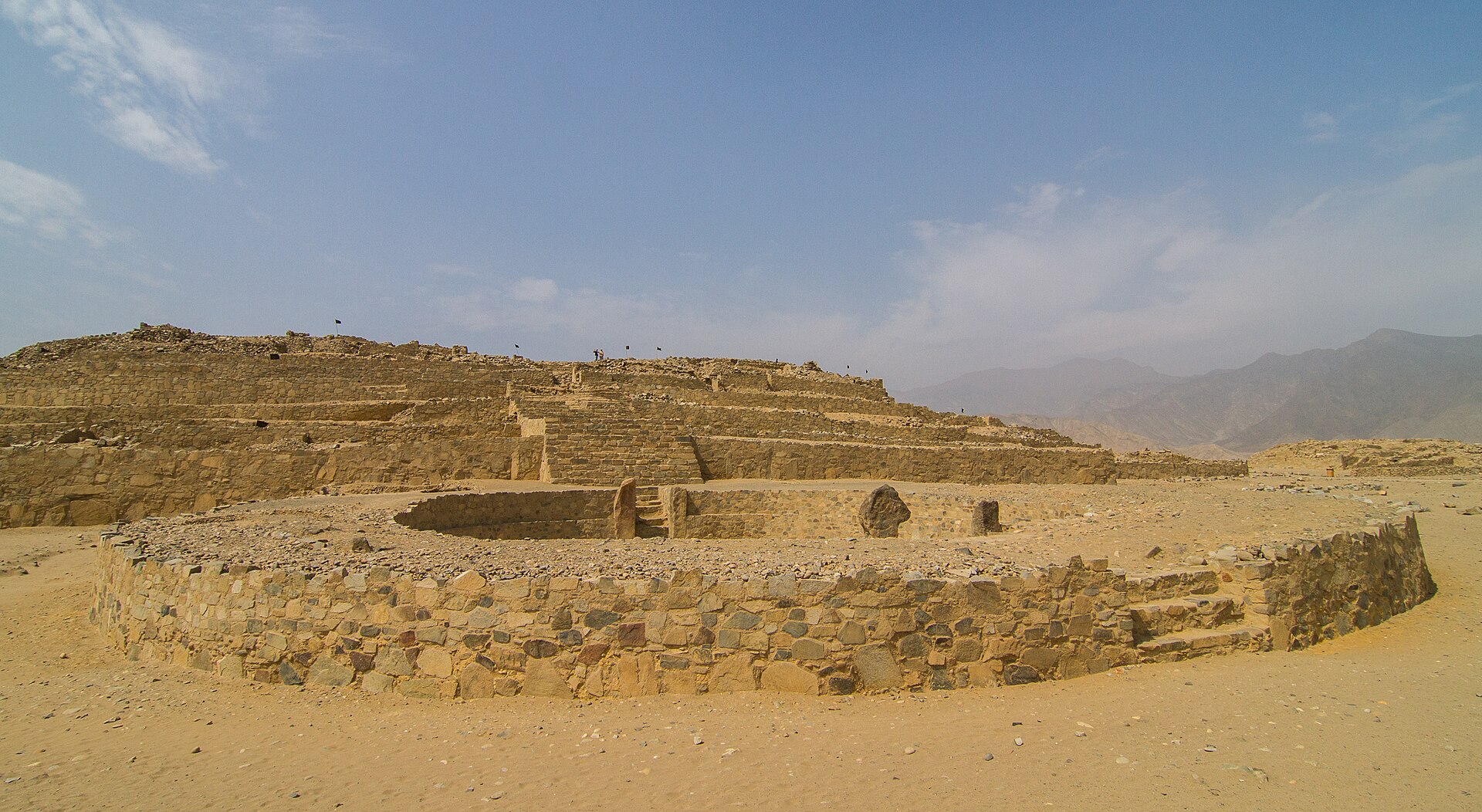
Fifteen hundred kilometres of coastline and four narrow river valleys hold the oldest civilization anyone has confirmed in the Americas. Norte Chico — named for the region, more often called Caral-Supe after its type site — begins as early as 3500 BCE at Huaricanga and reaches its clearest monumental form at Caral itself, in the Supe Valley, around 2627 BCE by radiocarbon dating published in Science in 2001. That date places Caral’s six pyramids under construction at roughly the same time as Egypt’s earliest pyramids, independently, on the other side of the world, with no contact between the two.
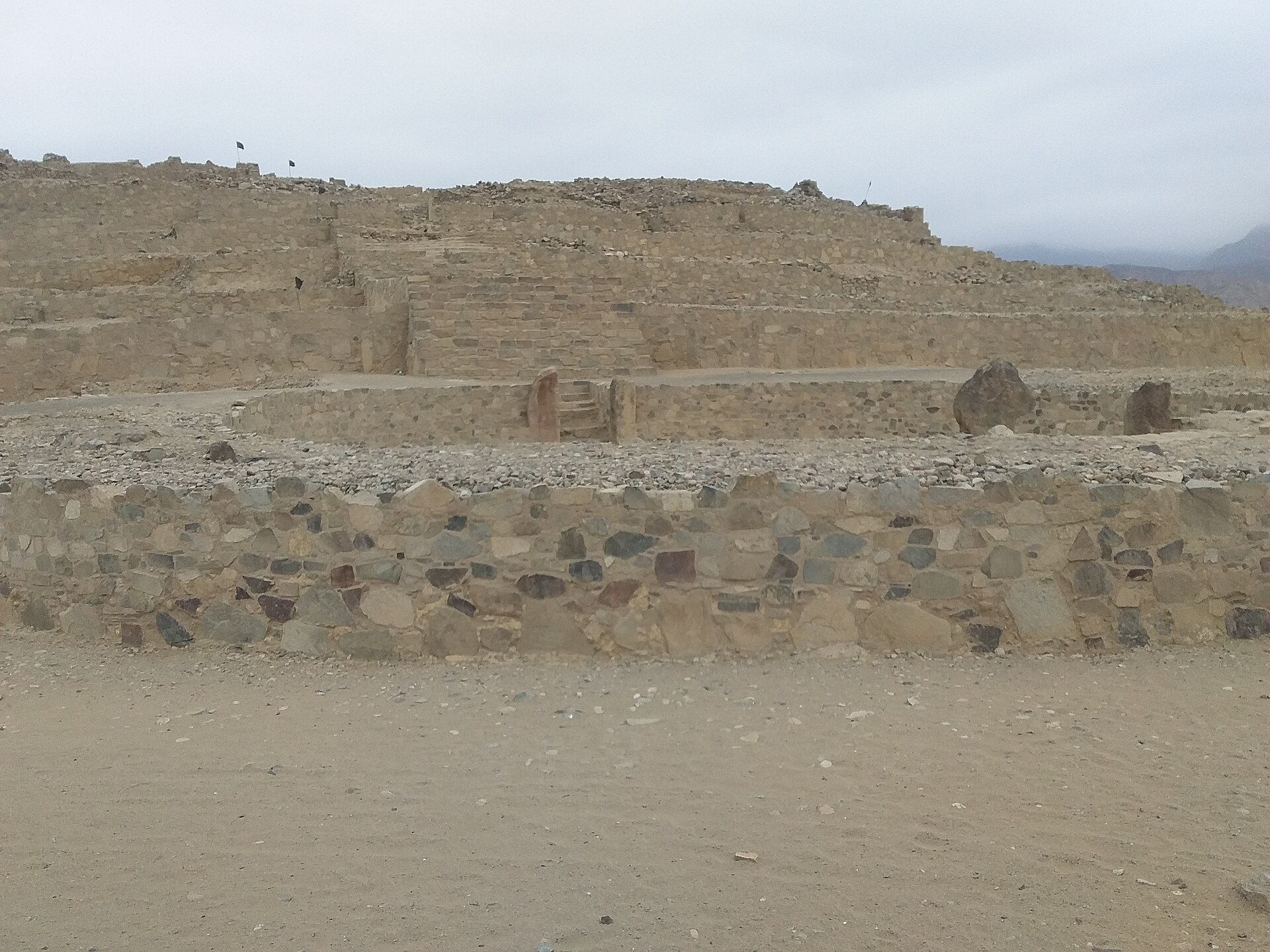
What makes Norte Chico strange isn’t its age. It’s what’s missing. Across some thirty excavated population centers, packed into 1,800 km² of desert valley, archaeologists have found no ceramics — the society ran on textiles and gourds instead of pots — no evidence of a writing system, and, after extensive survey, no evidence of warfare: no defensive walls, no weapon caches, no mass graves of violent death. It built monumental civic architecture — the Pirámide Mayor at Caral rises close to 30 metres over a base the size of four football fields, fronted by a sunken circular plaza that could hold hundreds — using shicras: bags woven from reeds, packed with quarried stone, and stacked inside retaining walls, a construction method flexible enough to survive the region’s earthquakes better than rigid masonry would. On one pyramid’s stairway, excavators found a quipu, the knotted-cord recording device usually associated with the Inca, two and a half thousand years earlier than expected. Elsewhere they found 32 flutes carved from pelican bone.
The civilization’s construction phase ends around 1800 BCE. A prolonged drought, part of a broader climate shift documented in sediment and pollen records, undercut the irrigation agriculture the valleys depended on. Research led by Ruth Shady — the archaeologist who excavated Caral from 1994 onward — traced what happened next: not a collapse so much as a migration. Displaced communities moved roughly 16 km inland to found Peñico, and to the coast to found Vichama, both built with Caral’s architectural vocabulary: temple pyramids, sunken circular plazas. At Vichama, the builders carved friezes of gaunt figures with visible ribs and sunken stomachs beside images of fish and a lightning-struck toad — a monument, in stone, to the hunger they had just survived.
But Peñico and Vichama were an afterlife, not a continuation. By around 1600 BCE the broader population had dispersed into more fertile ground further afield, taking their irrigation knowledge with them and leaving the monumental centers to be sealed rather than sacked — several were deliberately buried and closed, not looted or burned. No polity picked up where Norte Chico left off. The next major civilization usually named in Andean prehistory, Chavín, doesn’t appear until around 900 BCE — close to a thousand years of silence between the two. Nothing connects Caral-Supe politically or culturally to Chavín, to the Inca who came two and a half millennia later, or to any group living today. It predates the wheel finding its way here, predates any Andean empire, and it left behind flutes, cord-knots, and pyramids nobody needed defended.
Worth remembering
- No pottery, no known writing system, and — after decades of excavation across thirty sites — no evidence of warfare: no fortifications, no weapons caches, no mutilated remains. Music and record-keeping instead: 32 flutes carved from pelican bone, and a quipu (knotted-cord recording device) found on a pyramid stairway, centuries before quipu is otherwise attested.
- The Pirámide Mayor at Caral was built using shicras — bags woven from reeds, filled with stone quarried a mile away, and stacked inside retaining walls — a technique that let the structure flex rather than crack during the region's frequent earthquakes.
- When the drought that broke Caral hit around 4,200 years ago, the survivors didn't simply scatter: they founded Peñico inland and Vichama on the coast, and at Vichama they carved friezes of gaunt, hungry bodies next to fish and rain-signaling toads — a monument to the famine they had just survived.
The people
-
Ruth Shady Solís — Lead excavator
Peruvian archaeologist who began systematic excavation at Caral in 1994 and, with Jonathan Haas and Winifred Creamer, published the radiocarbon dating in Science (2001) that established Norte Chico as the oldest known civilization in the Americas. Later led the 2025 research tracing the drought-driven relocation to Peñico and Vichama.
Gallery
Sources
- Radiocarbon dates from Caral in the Supe Valley place monumental architecture, urban settlement and irrigation agriculture in the Americas as early as 4090 to 3640 years before present (2627-1977 calibrated BCE), contemporary with the earliest Egyptian pyramids; the site had no ceramics Science (Shady, Haas & Creamer, 2001)
- Caral-Supe was a complex Late Preceramic society of about thirty major population centers in the Norte Chico region of coastal Peru, flourishing from the 4th to the 2nd millennium BCE, the first city (Huaricanga) dated to c. 3500 BCE; the society built without ceramics, without a known writing system, and without evidence of warfare Wikipedia
- New research led by archaeologist Ruth Shady shows that roughly 4,200 years ago a prolonged drought hit the Supe region, disrupting agriculture and forcing abandonment of the monumental city of Caral; rather than collapsing outright, communities resettled nearby, founding Peñico in the Supe Valley and Vichama on the coast, carrying forward Caral's architectural and ceremonial traditions for a time Archaeology News Online Magazine
- At Vichama, a coastal site founded after Caral's decline, carved friezes depict skeletal figures with visible ribs and sunken stomachs, alongside pregnant women, dancers and abundant fish — imagery read as social memory of drought, hunger and subsequent recovery Archaeology News Online Magazine
- Caral's Pirámide Mayor stands nearly 100 feet (30 m) tall with a base covering roughly four football fields, fronted by a sunken circular plaza and a 30-foot staircase; its foundations used shicras, woven reed bags filled with quarried stone, a technique that gave the structures seismic resilience; excavators recovered 32 flutes made of pelican bone and a quipu on a stairway of the Gallery Pyramid Smithsonian Magazine
- The Chavín culture, the next widely recognized major Andean civilization after Norte Chico's decline, does not emerge until roughly 900 BCE — over a thousand years after Caral's monumental centers were abandoned; no direct successor state or polity is identified between them Wikipedia
A graveyard tradition: leave a stone to show you came, and remembered.