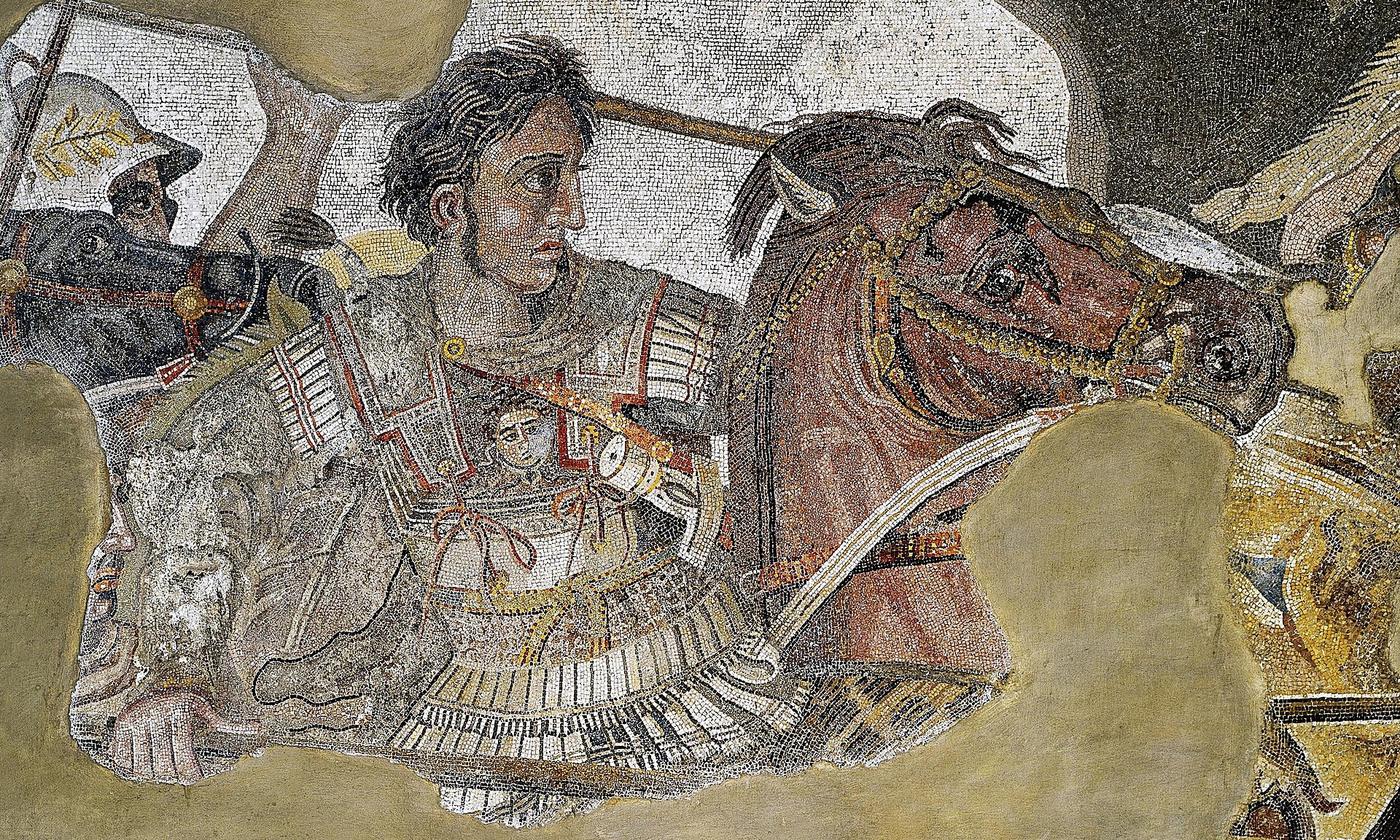
The Macedonian Empire is the classic case of a dominance built too fast to last. Philip II turned a fractious northern kingdom into the master of Greece — defeating Athens and Thebes at Chaeronea in 338 BCE and binding the city-states into the League of Corinth — and his son Alexander then crossed into Asia in 334 BCE and, in roughly ten years, conquered the entire Persian Empire and pushed on to the edge of India — the largest empire the world had ever seen, won by a single army that never lost a pitched battle. He planted Greek cities and Greek as a common tongue from the Nile to the Hindu Kush, seeding the Hellenistic age.
Then he died, in Babylon, at thirty-two, of fever or poison, with no grown heir and no agreed successor. Asked on his deathbed who should inherit, he is said to have answered “the strongest” — and his generals took him at his word. The empire did not so much fall as detonate: the Wars of the Diadochi carved it, over forty years, into rival Hellenistic kingdoms — Ptolemaic Egypt, the Seleucids, Antigonid Macedonia — that spent the next three centuries fighting one another until Rome and Parthia finished them off. The world Alexander made lasted for centuries; the empire itself lasted only as long as the man, and came apart over his unburied body.
Worth remembering
- At Gaugamela in 331 BCE, Alexander's army broke a far larger Persian force and ended the 220-year Achaemenid Empire; the captured treasuries of Persepolis and Susa reportedly needed thousands of pack animals to carry away.
- He founded some twenty cities named Alexandria in a single decade; the one in Egypt grew within a generation into the largest city in the western world, and outlived the empire that named it by nearly a thousand years.
Gallery
Watch
Sources
- Philip II defeated Athens and Thebes at Chaeronea (338 BCE) and led the League of Corinth (337 BCE), establishing Macedonian hegemony over Greece before Alexander's conquests. Encyclopaedia Britannica
- Alexander crossed into Asia in 334 BCE and died in Babylon on 10 June 323 BCE aged 32; his empire was the largest the world had seen, built in roughly a decade. World History Encyclopedia
- With no settled succession, the Wars of the Diadochi (322–272 BCE) fragmented Alexander's empire into the Ptolemaic, Seleucid, Antigonid and Attalid kingdoms. Oxford University Press
A graveyard tradition: leave a stone to show you came, and remembered.