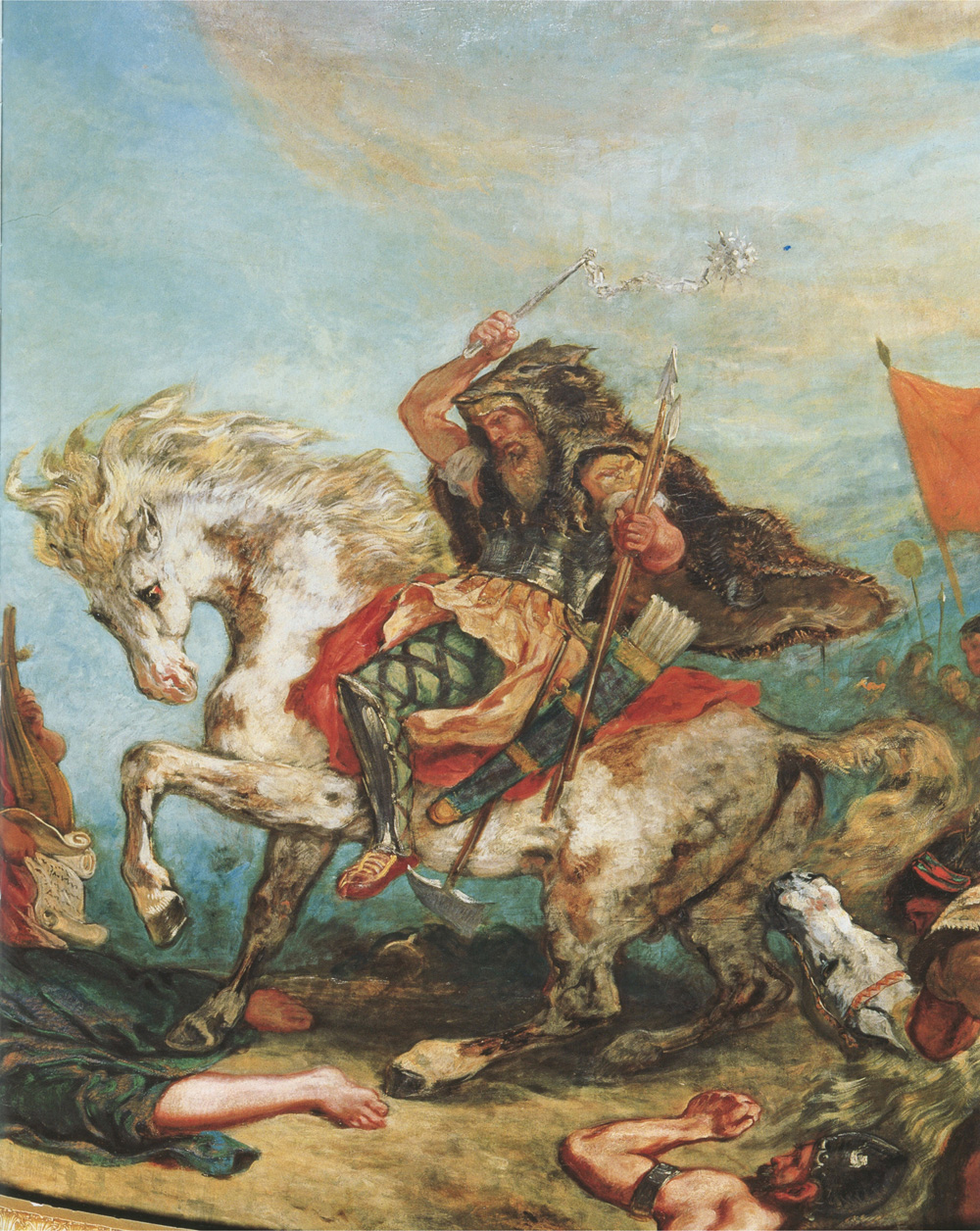
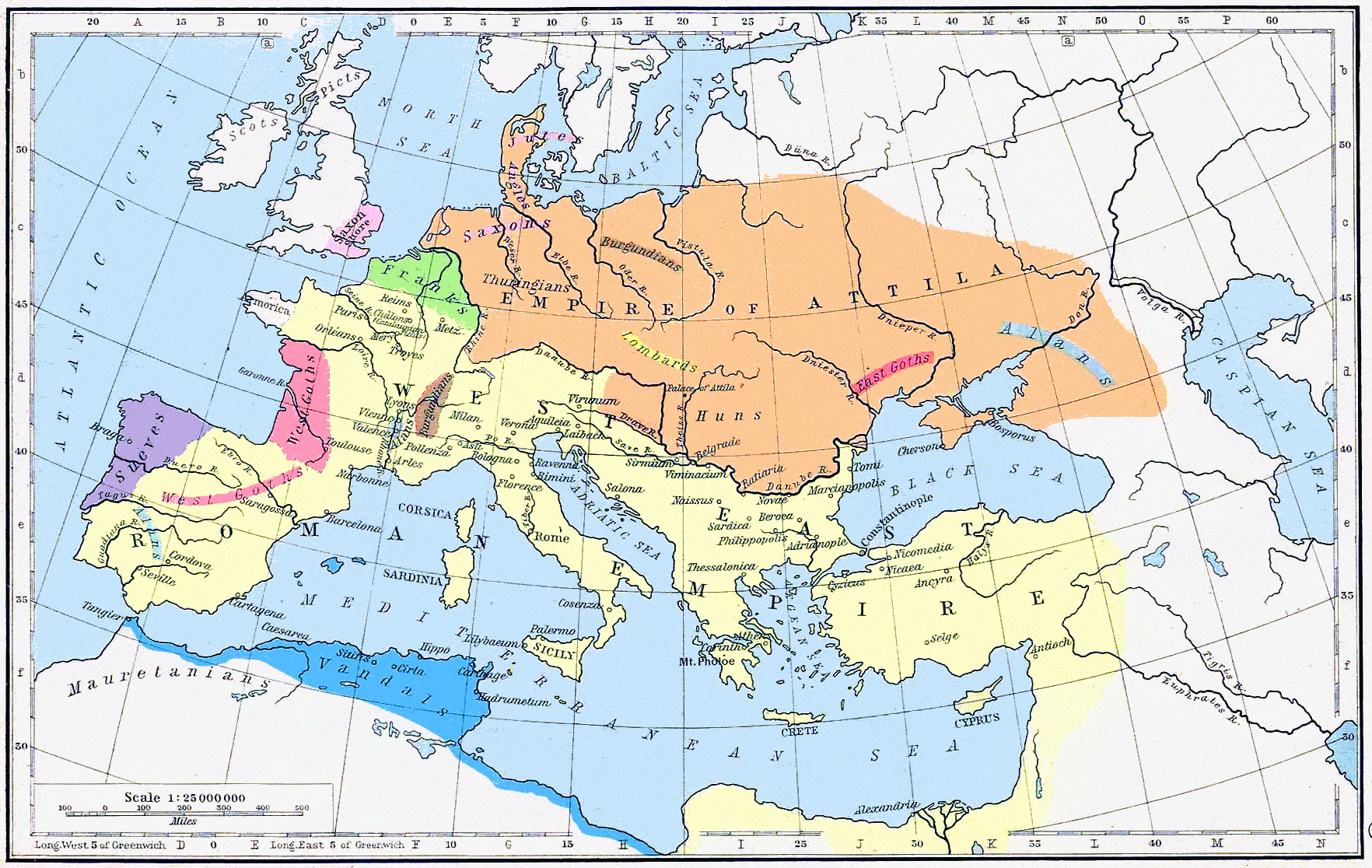
The Huns rode into Europe out of the Eurasian steppe around 370 CE, crossed the Volga, broke the Alans and shattered the Gothic kingdoms, pushing the Goths across the Danube and into the Roman Empire. For three generations they were the terror at the edge of two empires. Under Attila, who ruled from 434 until 453, the confederation reached from the Rhine to the Caspian, and both Romes paid to be left alone. By the Treaty of Margus in 439 the Eastern Roman Empire handed over 700 pounds of gold a year to Attila and his brother Bleda; after the campaigns of 441–442 the sum was more than tripled. Christian writers called Attila the scourge of God, flagellum dei, as he plundered the Balkans and then turned west. He invaded Gaul in 451 and was checked on 20 June at the Catalaunian Fields near Châlons, where the Roman general Aetius and the Visigoth king Theodoric I stopped his advance. He invaded Italy the next year, in 452, and withdrew.
Attila died in 453, choking on his own blood after a night of drinking on his wedding night. The empire did not outlive him. His sons fought each other for supremacy and squandered what he had held together by force. In 454 the subject peoples revolted: the Gepid king Ardaric led them against Attila’s sons at the Battle of Nedao, killed the eldest son Ellac, and broke Hunnic dominance over Central and Eastern Europe. Within a generation the confederation had dissolved and the Huns scattered among the peoples they had once ruled. They left almost no written record of their own, their language is unclassified, and nearly everything known about them survives in the accounts of the Romans they terrorised. A descent from the earlier Xiongnu of the Chinese frontier is often asserted but unproven; modern scholarship has largely rejected the link for lack of evidence, and the two are kept distinct here.
Worth remembering
- Christian writers called Attila the 'scourge of God' (flagellum dei); under the Treaty of Margus (439 CE) the Eastern Roman Empire paid 700 pounds of gold a year to Attila and his brother Bleda, a tribute later more than tripled after the campaigns of 441–442 CE.
- On 20 June 451 CE at the Catalaunian Fields near Châlons in Gaul, the Roman general Aetius and the Visigoth Theodoric I defeated Attila and stopped his advance; Attila invaded Italy in 452 and died in 453, and at the Battle of Nedao (454) his former subjects under the Gepid king Ardaric destroyed the Huns.
Gallery

Sources
- The Huns conquered the Alans c. 370 CE and drove the Gothic groups into Roman territory by 376; after Attila's death his sons fought each other and the empire fell apart, with the Gepid king Ardaric defeating Attila's son Ellac at the Battle of Nedao (454), after which other nations broke away from Hunnic control. Modern scholarship has largely rejected the Xiongnu–Hun link for lack of evidence. World History Encyclopedia
- Attila reigned 434–453 CE, was called the 'scourge of God' (flagellum dei), and under the Treaty of Margus (439 CE) Rome paid 700 pounds of gold annually to Attila and Bleda, a sum later more than tripled after the campaigns of 441–442; he died in 453. World History Encyclopedia
- At the Battle of the Catalaunian Fields (Châlons) on 20 June 451 CE in Gaul, Roman forces under Flavius Aetius with the Visigoth Theodoric I defeated Attila's Huns and stopped the Hunnic invasion of Europe; Attila invaded Italy the following year (452) and died in 453. World History Encyclopedia
A graveyard tradition: leave a stone to show you came, and remembered.