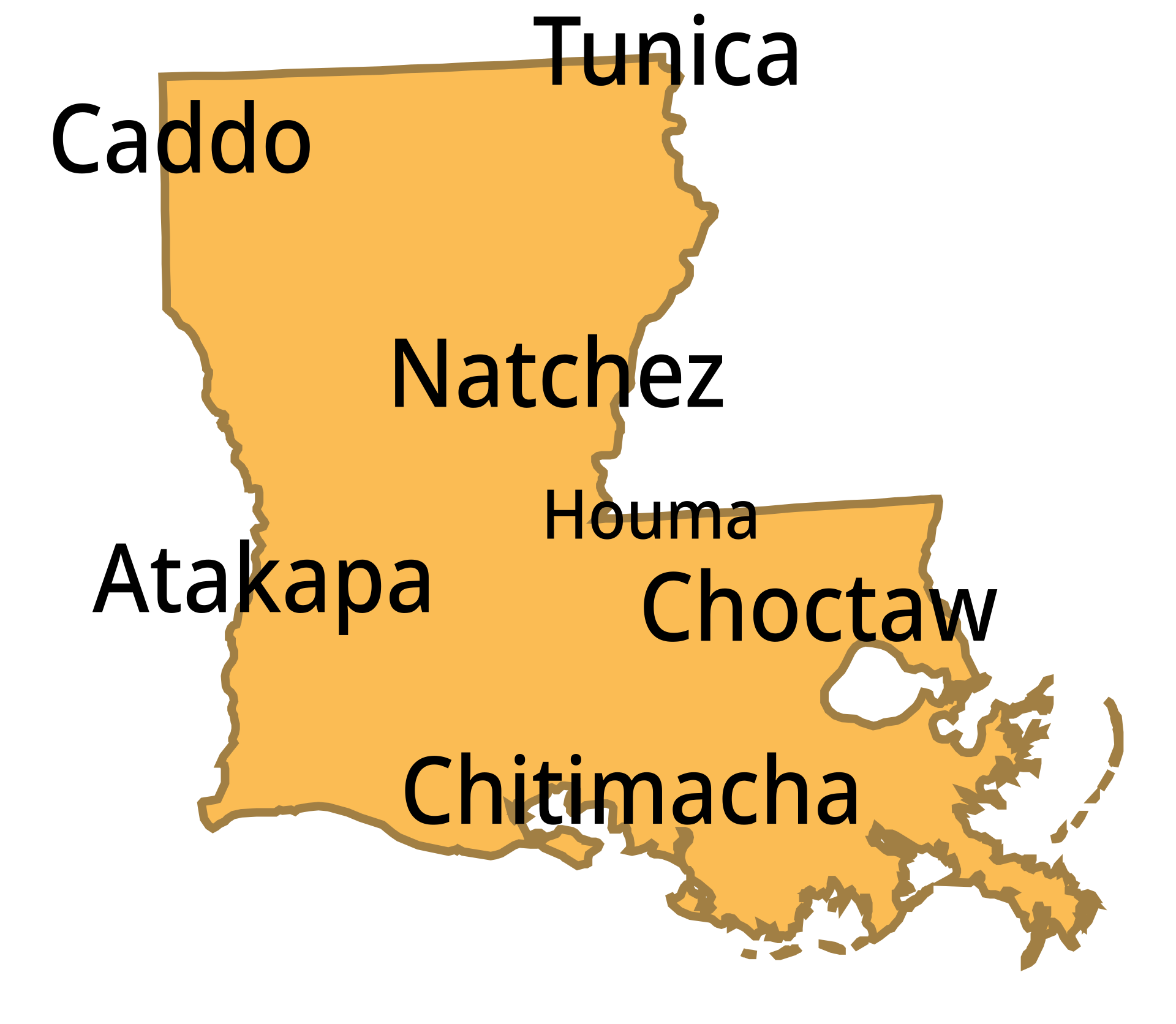
Tunica was a language isolate of the lower Mississippi, spoken in what is now Louisiana and Mississippi. It carried tone — pitch contours that changed a word’s meaning — over seven vowels, rare among the languages of the valley.
Epidemics and warfare cut the Tunica down from the seventeenth century on, and for daily life they leaned on the Mobilian trade jargon and on French while the language itself drew back into memory. By the twentieth century it lived in one man, Sesostrie Youchigant, who gave it to the linguist Mary Haas in the 1930s and ’40s — a grammar, texts, a dictionary — before he died on 6 December 1948. The Tunica-Biloxi Tribe now teaches it again from those books, to about sixty learners, none of them native.
Worth remembering
- It was a tonal isolate, using pitch over seven vowels to distinguish meaning — unusual in the Mississippi Valley.
- By the time Mary Haas worked with Sesostrie Youchigant in the 1930s and 1940s he was its sole source; without those sessions Tunica would have left almost no usable record.
Sources
- Tunica was a tonal language isolate of Louisiana; its last native speaker, Sesostrie Youchigant, died on 6 December 1948, documented by Mary Haas Wikipedia
- Tunica is classified as extinct, with about 60 second-language learners as of 2023 Glottolog
- The Tunica-Biloxi Tribe's Language and Culture Revitalization Program, launched in 2010 in partnership with Tulane University's Linguistics Department, runs four 8-week series of Tunica language classes each year and has produced a Tunica-English dictionary available via mobile app. Tunica-Biloxi Tribe of Louisiana
A graveyard tradition: leave a stone to show you came, and remembered.